

Can a 2CH CWDM Mux Demux be used in a transportation network?
In the realm of modern transportation networks, the demand for high - speed, efficient, and reliable data transmission has never been higher. As a leading supplier of 2CH CWDM Mux Demux, I am often asked whether our product can be used in a transportation network. In this blog post, I will delve into this question, exploring the technical aspects, benefits, and potential challenges of integrating a 2CH CWDM Mux Demux into a transportation network.
Understanding 2CH CWDM Mux Demux
Before we discuss its application in transportation networks, let's briefly understand what a 2CH CWDM Mux Demux is. CWDM stands for Coarse Wavelength Division Multiplexing. It is a technology that allows multiple optical signals of different wavelengths to be transmitted simultaneously over a single optical fiber. A 2CH CWDM Mux Demux, as the name suggests, is designed to multiplex (combine) and demultiplex (separate) two optical signals of different wavelengths.
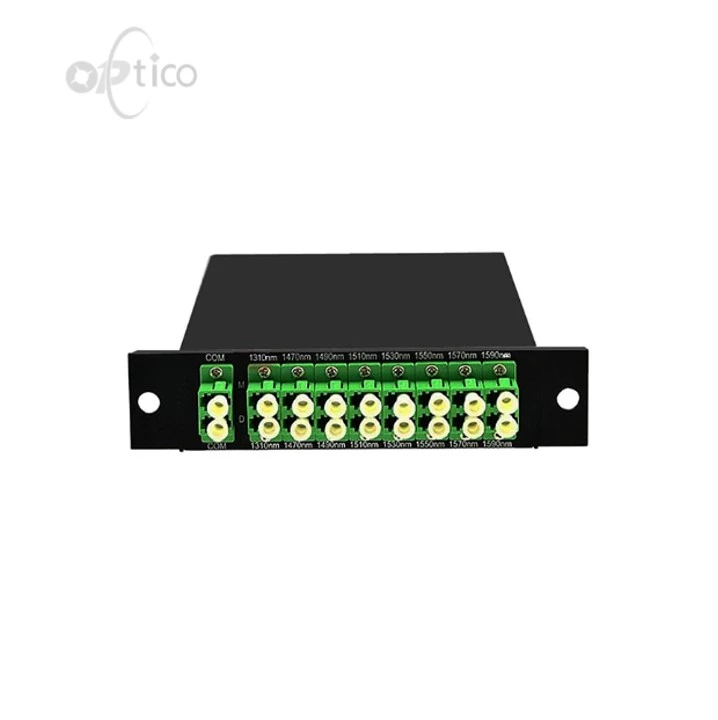

The main advantage of CWDM technology is its cost - effectiveness compared to Dense Wavelength Division Multiplexing (DWDM). It uses wider wavelength spacing, which means less precise and thus less expensive components can be used. A 2CH CWDM Mux Demux is a simple yet powerful device that can significantly increase the capacity of an optical fiber link by allowing two different data streams to share the same physical medium.
Requirements of Transportation Networks
Transportation networks, whether they are railway, highway, or aviation - related, have unique requirements for data transmission. First and foremost, they need high - reliability communication. For example, in a railway network, real - time data such as train position, speed, and track conditions need to be transmitted accurately and without interruption to ensure the safety of passengers and the smooth operation of the trains.
Secondly, transportation networks often cover large geographical areas. This requires long - distance data transmission capabilities. The optical fiber is a natural choice for such applications due to its low attenuation and high - bandwidth characteristics.
Finally, cost - efficiency is also a crucial factor. Transportation operators need to balance the performance and cost of the communication systems they deploy. They need solutions that can provide high - quality data transmission at a reasonable price.
Can a 2CH CWDM Mux Demux Meet the Requirements?
High - Reliability Communication
A 2CH CWDM Mux Demux can contribute to high - reliability communication in transportation networks. Since it uses optical fibers for data transmission, it is less susceptible to electromagnetic interference compared to traditional copper - based communication systems. Optical fibers are also more durable and have a longer lifespan, reducing the risk of communication failures due to cable damage.
Moreover, the design of the 2CH CWDM Mux Demux is relatively simple, with fewer components that can potentially fail. This simplicity translates into higher reliability. In addition, some 2CH CWDM Mux Demux devices are equipped with monitoring and alarm functions, which can detect any abnormal conditions in the optical link and notify the operators in time.
Long - Distance Data Transmission
Optical fibers, which are used in conjunction with 2CH CWDM Mux Demux, are well - suited for long - distance data transmission. The low attenuation of optical fibers allows the optical signals to travel over long distances without significant loss of signal strength. A 2CH CWDM Mux Demux can multiplex two different data streams onto a single fiber, enabling the simultaneous transmission of multiple types of data over long distances.
For example, in a highway transportation network, traffic flow data and surveillance camera video can be transmitted over the same fiber using a 2CH CWDM Mux Demux. This not only saves the cost of laying multiple fibers but also simplifies the network infrastructure.
Cost - Efficiency
As mentioned earlier, CWDM technology is more cost - effective than DWDM. A 2CH CWDM Mux Demux is relatively inexpensive compared to more complex multiplexing devices. It does not require the use of expensive lasers and filters, which makes it an attractive option for transportation operators who are looking for cost - efficient communication solutions.
In addition, the installation and maintenance of a 2CH CWDM Mux Demux are relatively straightforward. This further reduces the overall cost of ownership for transportation networks.
Potential Applications in Transportation Networks
Railway Networks
In railway networks, a 2CH CWDM Mux Demux can be used to transmit data between train control centers, stations, and trains. One channel can be used for train control data, which is critical for ensuring the safety of train operations. The other channel can be used for passenger information systems, such as real - time train schedules and announcements.
By using a 2CH CWDM Mux Demux, railway operators can increase the capacity of their existing optical fiber links without the need for expensive infrastructure upgrades.
Highway Networks
For highway networks, a 2CH CWDM Mux Demux can be used to connect traffic management centers, toll booths, and surveillance cameras. One channel can be dedicated to traffic flow data, which helps traffic managers to optimize traffic flow and reduce congestion. The other channel can be used for video surveillance, providing real - time images of the highway conditions.
This allows for more efficient management of highway networks and improves the safety of drivers and passengers.
Aviation Networks
In aviation networks, a 2CH CWDM Mux Demux can be used to transmit data between airports, air traffic control centers, and aircraft. One channel can be used for flight control data, which is essential for the safe take - off, flight, and landing of aircraft. The other channel can be used for passenger communication services, such as in - flight Wi - Fi and entertainment systems.
Challenges and Considerations
While a 2CH CWDM Mux Demux has many advantages for transportation networks, there are also some challenges and considerations.
Wavelength Compatibility
It is important to ensure that the wavelengths used by the 2CH CWDM Mux Demux are compatible with the existing optical network infrastructure. Different transportation networks may have different wavelength requirements, and the wrong choice of wavelengths can lead to signal interference and reduced performance.
Scalability
A 2CH CWDM Mux Demux can only multiplex and demultiplex two optical signals. In some cases, as the demand for data transmission in transportation networks grows, more channels may be required. In such situations, transportation operators may need to consider upgrading to higher - channel CWDM modules, such as 4CH CWDM Module, 8CH CWDM Module, or 16CH CWDM Module.
Environmental Conditions
Transportation networks often operate in harsh environmental conditions, such as extreme temperatures, humidity, and vibration. The 2CH CWDM Mux Demux needs to be able to withstand these conditions to ensure reliable operation. Some 2CH CWDM Mux Demux devices are designed with rugged enclosures and temperature - compensated components to meet these requirements.
Conclusion
In conclusion, a 2CH CWDM Mux Demux can be a valuable addition to a transportation network. It can provide high - reliability, long - distance, and cost - efficient data transmission, which are the key requirements of transportation networks. It has potential applications in railway, highway, and aviation networks, helping to improve the efficiency and safety of transportation systems.
However, transportation operators need to carefully consider the challenges and limitations, such as wavelength compatibility, scalability, and environmental conditions. If you are a transportation operator looking for a reliable and cost - effective communication solution, I encourage you to contact us to discuss how our 2CH CWDM Mux Demux can meet your specific needs. Our team of experts is ready to provide you with detailed technical support and solutions tailored to your transportation network.
References
- "Optical Communication Systems" by Gerd Keiser
- "Wavelength Division Multiplexing (WDM) Technology and Applications" by various authors in IEEE Journals
- Industry reports on transportation network communication systems from market research firms.