

why choose us
Quality Assurance
OPTICO has passed ISO9001-2015/CE/CPR/ROHS/FCC certification and have reliability test reports from 3rd party lab.
Strong Production Capacity
OPTICO has developed its total production area to 20,000 square meters, and has 400 production and testing equipments.
Professional Team
OPTICO team will respond you within 12 hours to provide the most suitable rather than the most expensive solutions.
Responsibility
With OPTICO scientific quality monitoring and warehouse tracking system, it solves every unexpected problem honestly and quickly.
What is Mux Demux
A multiplexer (or mux; spelled sometimes as multiplexor), also known as a data selector, is a device that selects between several analog or digital input signals and forwards the selected input to a single output line. The selection is directed by a separate set of digital inputs known as select lines.
What is OADM
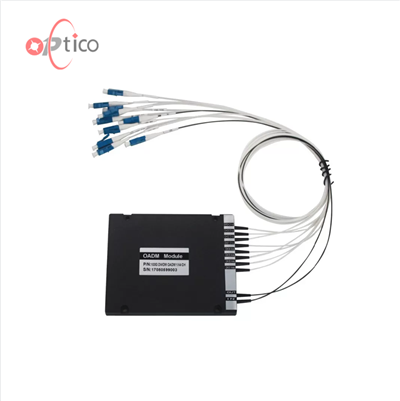
An Optical Add/Drop Multiplexer (OADM) is a Wavelength Division Multiplexing (WDM) networking device that has access to all wavelengths on a fiber and allows for specific wavelengths to be dropped or added at a location while also allowing other wavelengths to optically pass through the site without requiring termination. OADMs enable wavelength reuse by allowing a wavelength (i.e., wavelength1) to drop from one direction without continuing through the site, so that the same wavelength can also be added to be transported towards the opposite direction.




Advantages of Mux Demux


Data Routing
A multiplexer (MUX) is a combinational logic circuit that allows multiple input signals to be selectively routed to a single output. It provides a convenient way to handle and control multiple data sources and direct them to the desired destination based on control signals. This routing capability makes multiplexers versatile and widely used in various applications.
Resource Efficiency
By using a multiplexer, you can reduce the number of physical components required in a circuit. Instead of using separate logic gates or switches for each input signal, a multiplexer can be used to consolidate the inputs and efficiently manage the routing. This can result in significant space and cost savings in large-scale digital systems.
Reduced Complexity
Multiplexers simplify the design and implementation of complex logic functions. They can be used to implement various logic operations, such as AND, OR, and XOR, by appropriately selecting the inputs and control signals. This reduces the number of logic gates needed and simplifies the overall circuit design.
Time Division Multiplexing
Multiplexers are commonly used in communication systems for time division multiplexing (TDM). TDM allows multiple signals to be transmitted over a single communication channel by dividing the available time slots among different sources. Multiplexers efficiently handle the switching and synchronization required for TDM, enabling efficient data transmission.
Address Decoding
Multiplexers are often used for address decoding in memory systems. In this application, the multiplexer's inputs represent different memory locations, and the control signals determine which memory location is selected. By using a multiplexer for address decoding, the memory system can easily access the desired memory location based on the input address.
Data Compression
Multiplexers can be used for data compression in certain applications. By selectively combining multiple input signals into a single output, a multiplexer can reduce the amount of data that needs to be transmitted or stored. This can be particularly useful in situations where bandwidth or storage capacity is limited.
Signal Conditioning
Multiplexers can perform signal conditioning tasks such as amplification, attenuation, or filtering. By routing the input signals through appropriate conditioning circuitry before selecting the output, multiplexers can help optimize the quality and characteristics of the signals.
Signal Integrity
Multiplexers can help maintain signal integrity in high-speed digital circuits. They can act as buffers or drivers, ensuring that the signals propagate properly without degradation or distortion. Multiplexers with high-speed capabilities and low signal skew are commonly used in applications where signal integrity is critical, such as in data transmission or clock distribution.
Logic Function Implementation
Multiplexers can be used to implement complex logic functions or generate specific control signals. By properly configuring the inputs and control signals, a multiplexer can perform various logical operations, such as generating a carry or implementing a programmable logic function. This flexibility and versatility make multiplexers valuable in digital system design.
Reduced Power Consumption
In some cases, using a multiplexer can lead to lower power consumption compared to alternative circuit implementations. By consolidating inputs and reducing the number of active components, multiplexers can help minimize power dissipation in digital circuits. This can be advantageous in battery-powered devices or systems with strict power constraints.
Scalability
Multiplexers are highly scalable and can handle a large number of inputs. By cascading multiple multiplexers together, you can effectively increase the number of input signals that can be managed. This scalability makes multiplexers suitable for applications that require the handling of a large amount of data or inputs.
For analog signals in telecommunications and signal processing, a time division multiplexer may select multiple samples of separate analog signals and combine them into one pulse amplitude modulated (PAM) wide-band analog signal. When there are two input signals and one output signal, a MUX is referred to as a 2-to-1 multiplexer; with four input signals it is a 4-to-1 multiplexer — and so on.
For digital signals in telecommunications on a computer network or with digital video, several variable bit-rate data streams of input signals (using packet mode communication) may be combined, or multiplexed, into one constant bandwidth signal. With an alternate method utilizing a TDM, a limited number of constant bit-rate data streams of input signals may be multiplexed into one higher bit-rate data stream.
A multiplexer requires a demultiplexer to complete the process, to separate multiplex signals carried by the single shared medium or device. Often a multiplexer and a demultiplexer are combined into a single device (also often just called a multiplexer) in order to allow the device to process both incoming and outgoing signals.
Alternately, a multiplexer’s single output may be connected to a demultiplexer’s single input over a single channel. Either method is often used as a cost-saving measure. Since most communication systems transmit in both directions, the single combined device, or two separate devices (as in the latter example), will be needed at both ends of the transmission line.
Applications of Mux Demux
Networking Applications
Networking solutions leverage multiplexers, notably in devices like Ethernet switches. These multiplexers enable multiple devices to communicate on the same network by adeptly selecting the appropriate communication line for each device. This ensures efficient and organized data exchange in network environments.
Audio-Video Broadcasting
In audio-visual broadcasting, multiplexers play a pivotal role in receiving channels from different satellite transponders concurrently. Achieving this involves a single receiver box with its antenna directed toward a single satellite dish. Multiplexers can be used as individual receivers pointing in various directions, optimizing the reception process.
Automotive Applications
Automotive engineering uses multiplexing technology to amalgamate signals from a vehicle’s sensors and controllers into a unified digital signal. This consolidated signal facilitates communication over the onboard computer network, contributing to streamlined data management within the vehicle.
Line Sharing in Telephone Networks
Telephone networks utilize multiplexers for efficient line sharing between different devices, such as fax machines and telephones. Integrating multiplexers into complex network configurations allows for the prioritization of line access among various devices, optimizing communication and resource utilization.
Computer Memory
Multiplexers find application in computer memory systems to manage extensive memory capacities efficiently. They contribute to the reduction of copper lines needed to connect memory components to various parts of the computer. This streamlined connectivity enhances the overall performance and manageability of computer memory.
Mux Demux Design and Architecture

Multiplexer Design and Architecture
Depending on the number of inputs, outputs, and control lines, a multiplexer is designed differently. Activating the control line enables each input line to be transmitted to the output, which corresponds to a binary code on the input line. To form the basic structure of a multiplexer, AND, OR, and NOT gates are most commonly used.

Integration with Other Digital Devices
Various digital devices can be integrated with multiplexers to provide a multitude of functions. To manage bidirectional data flow, multiplexers and demultiplexers are commonly integrated into communication systems. Data transmission systems also use them in conjunction with encoders and decoders to efficiently convert signals and route them.

Future Trends
The role of multiplexers is bound to grow even more important with the exponential growth of data traffic and digital communications. Eventually, multiplexers may be developed that are more advanced and efficient, capable of integrating with other digital systems and handling larger data inputs.
The Structure of Mux Demuxs
A typical multiplexer is made up of three main components: input lines, select lines, and an output line. The multiplexer’s operation is governed by a set of selection rules determined by the select lines.
Input Lines: The multiplexer takes multiple inputs which are usually binary in nature.
Select Lines: These are essentially control signals that determine which input should be forwarded to the output line.
Output Line: There’s only a single output line which carries the selected input signal.

Multiplexers are data selectors. A multiplexer circuit selects between several input signals and forwards the selected input to a single output line. The multiplexer can be considered as a multiple-input, single-output switch. As logic ICs (integrated circuits), multiplexer circuit inputs and outputs can be represented in a multiplexer truth table.
Demultiplexers, on the other hand, are data distributors. They are combination data distribution logic circuits. A demultiplexer is connected to a single input signal and selects one of several output lines to share the signal. So, the demultiplexer can be considered as a single-input, multiple-output switch.
Multiplexer devices select one signal line from a number of digital or analogue data lines. They then pass it through the circuit to the selected output. By contrast, demultiplexers receive a single input signal and through the circuit select the output from a number of digital or analogue data lines.
Some multiplexers are designed to handle high voltages, which makes them suitable for industrial applications where high voltage signal switching is common, such as ultrasonic monitoring, tests and measurements, and industrial automation.
Types of OADM
Fixed Optical Add-Drop Multiplexer (FOADM)
FOADMs use fixed filters that add/drop a selected wavelength and pass the rest of the wavelengths through the node. Static wavelength-filtering technology eliminates the cost and attenuation to demultiplex all DWDM signals in a signal path. The solution is called FOADM because the wavelengths added and dropped are fixed at the time of add/drop filter installation on the optical path through a node.
Reconfigurable Optical Add-Drop Multiplexers (ROADM)
Reconfigurable Optical Add Drop Multiplexers (ROADMs) are used to provide flexibility in rerouting optical streams, bypassing faulty connections, allowing minimal service disruption and the ability to adapt or upgrade the optical network to different WDM technologies my electronically configuring the OADM to achieve the required functionality.
In conventional long-haul transmission systems, emphasis has been placed on how much capacity and how far the system can transmit. In metro/access networks, however, low cost and system flexibility are strongly required. OADM canverify both demands. The main battlefield of OADM application is in MAN (metropolitan area network), featuring high flexibility, easy upgrade and amplification. As an ideal multi-services transport platform in MAN application, OADM also allows different wavelength multiplexing signal at different locations. Another application for OADM is in Optical Cross Connection (OXC). Proposed equipment allows different networks to connect dynamic, on-demand wavelength resources and a wider range of network interconnection. OADM and OXC only need to download the information in the nodes to send the person that handles the equipment, including ATM switchboard, SDH switchboard, IP router etc., which greatly improve the efficiency of the node to process information.

Configurations of OADM
Thin-film filter (TFF)
For OADM configuration with TFF, an arbitrary signal wavelength is branched/dropped from wavelength-multiplexed signals via a narrow band-pass filter (BPF), whereby only the desired signal wavelength being transmitted while others reflected. Meanwhile, an arbitrary signal wavelength can be inserted/added into wavelength-multiplexed signals via a narrow BPF, whereby the desired signal wavelength being transmitted is combined with the reflected signal wavelengths.
Fiber bragg grating (FBG)
While configuring an OADM with FBG, the wavelength-multiplexed signals enter an FBG through a circulator, where only one arbitrary signal wavelength is reflected while others are transmitted. The reflected signal wavelength is branched/dropped into a port other than that where the wavelength-multiplexed signals enter. In the case of wavelength multiplexing an arbitrary signal wavelength, the signal wavelength incident on the circulator is reflected by the FBG, and is inserted/added into the wavelength-multiplexed signals that are transmitted via the circulator.
OADM in the Metropolitan Network Development Tendency
Arbitrary choice must be retrieved, adding wavelength, the wavelength can take advantage of the limited resources, the node can be retrieved with the need to do to join the adjustment of the signal wavelength, and has a remote control functions. This can provide dynamic reconfiguration of optical communications network capable ROADM will be connected to the backbone network critical devices. And FOADM is used for wavelength demand network access will be smaller parts to reduce costs. Furthermore, ROADM use to all kinds of Tunable Laser, unable Filter, or wavelength selective optical switches and other components.
Must be able to convert incompatible wavelength suitable for the backbone network will be transmitted wavelengths. Therefore, OADM be combined with wavelength conversioin transponder or other functional components.
Must be able to compensate for the node to make acquisistion, adding such action energy loss. Therefore, OADM optical amplifiers must be combined with functional components.
Wavelength signals related specifications, such as: the signal to noise ratio (S/N), the energy balance between the signal wavelength, etc., are required to meet network requirements. Therefore must be combined OADM Variable Optical Attenuator (VOA), dispersion compensation module (DCM) and other components.
Considerations When Choosing an OADM
Wavelength Compatibility
Different OADMs and mux demux have specific wavelength ranges and intervals that they support. Ensuring that the chosen OADM is wavelength-compatible with the mux demux in the WDM network is crucial, as it directly impacts the proper functioning of the OADM. If the wavelength of OADM does not match that of MUX, it will be impossible to correctly schedule optical signals.
Network Topology
When choosing an OADM, whether it's a single-fiber or dual-fiber configuration is also a crucial consideration. In a dual-fiber structure, the input and output signals of OADM are transmitted through two separate optical fibers, allowing it to use different fibers between input and output. In a single-fiber configuration, the input and output signals of OADM are transmitted through the same optical fiber, requiring OADM to use the same fiber for both transmitting and receiving signals.
Insertion Loss and Performance
Insertion loss refers to the power loss incurred when a signal passes through a device or component. This directly affects the transmission quality of the signal. Larger insertion loss may result in significant power loss during the transmission process, thereby reducing signal quality and potentially causing distortion or failure to receive the signal properly, especially in long-distance transmissions. A low insertion loss OADM can reduce the optical signal loss during the process of adding and separating signals, thus ensuring communication quality. This is indispensable in the optical transmission link.
Port Count
The selected OADM's port count directly impacts its ability to add and remove signals. Ensuring that the OADM's port count aligns with the network's requirements while considering future scalability to accommodate potential demand growth is one of the key factors in guaranteeing the effective management and operation of different wavelength signals within the network.
Add-Drop Functionality
The add-drop functionality of OADM determines its ability to selectively add or remove specific wavelengths.When selecting an OADM, you should consider whether it can provide enough add and drop channels to meet specific wavelength addition and dropping needs.
Management and Monitoring Capabilities
The selected OADM should feature the necessary management and monitoring functions for easy configuration, monitoring, and management of the add-drop process. This is pivotal for network maintenance and troubleshooting.
International Certificates




Shenzhen OPTICO Communication Co., Ltd was established in April, 2008. Over the next 13 years, OPTICO expanded and increased its production because of the contracts with many EU Telecom Companies. OPTICO's main products fields including Indoor/Outdoor Fiber Cable, Data Center Fiber Patch cord, PLC Splitter, CWDM/DWDM/AWG/FWDM, SFP transceiver, and Media converter. All of products have passed CE, FCC, ROHS, ISO, ROHS certifications.
FAQ
We're professional mux demux and oadm manufacturers and suppliers in China, specialized in providing high quality customized service. We warmly welcome you to buy high-grade mux demux and oadm in stock here from our factory. Contact us for more details.
fiber optic mux demux for access control systems, optical oadm for chemical process control, wdm oadm for radiation monitoring