

why choose us
Quality Assurance
OPTICO has passed ISO9001-2015/CE/CPR/ROHS/FCC certification and have reliability test reports from 3rd party lab.
Strong Production Capacity
OPTICO has developed its total production area to 20,000 square meters, and has 400 production and testing equipments.
Professional Team
OPTICO team will respond you within 12 hours to provide the most suitable rather than the most expensive solutions.
Responsibility
With OPTICO scientific quality monitoring and warehouse tracking system, it solves every unexpected problem honestly and quickly.
What is Fiber Cable
A fiber optic cable is a network cable that contains strands of glass fibers inside an insulated casing. They're designed for long-distance, high-performance data networking, and telecommunications. Compared to wired cables, fiber optic cables provide higher bandwidth and transmit data over longer distances. Fiber optic cables support much of the world's internet, cable television, and telephone systems.


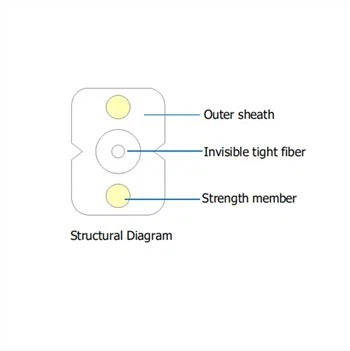


Optical fiber cable is manufactured to meet optical, mechanical or environmental performance specifications, it is a communication using one or more optical fibers placed in a sheath as the transmission medium and can be used individually or in groups cable assembly. Optical cables are mainly composed of optical fibers (glass filaments as thin as hair), plastic protective sleeves and plastic outer skins. There are no metals such as gold, silver, copper and aluminum in the optical cables, and generally have no recycling value. Optical cable is a kind of communication line in which a certain number of optical fibers form a cable core according to a certain method, which is covered with a sheath, and some are also covered with an outer sheath to realize optical signal transmission. That is: a cable formed by an optical fiber (optical transmission carrier) through a certain process. The basic structure of optical cable is generally composed of cable core, reinforcing steel wire, filler and sheath, etc. In addition, there are waterproof layer, buffer layer, insulated metal wire and other components as needed.
Advantages of Fiber Cable


Faster speeds
Copper wires transmit data via an electrical current, which is pretty fast at somewhere between 10 Gbps and 40 Gbps depending on the type and length of cable used. Fiber cables are much faster, however, carrying data up to Terabits per second per second. Copper also comes with limited future bandwidth, which is the amount of speed available for use. While copper is pretty much topped out, fibre optic technology is likely to improve beyond its current rate, which sits 31% slower than the speed of light.
Greater distances
Fiber cables work much better over long distances, which makes them ideal for regional and remote areas. Not only is fibre much faster than copper, but it's also not subject to copper's 100 m distance limitation. This length constraint is inherent with all unshielded twisted pair copper lines, unless you use a booster. While distances in the real world often range from 550 m for 10 Gbps multi-mode cables to 40 km for single-mode cable, data and security standards are compromised when cables are extended. In contrast, fiber cables feature extremely low signal degradation, with regeneration only needed when lines extend for hundreds of kilometres.
Enhanced durability
Fiber cables are more resilient than copper cables, with fibre networks likely to experience enhanced durability in diverse environmental and operating conditions. While thin ultra-light strands of glass don't usually inspire confidence, fiber cables are surprisingly tough. Fibre doesn't corrode in salty air, it can be bent around corners, and it withstands storms and extreme weather events. It also takes up much less space than copper, which makes it more versatile and easier to handle. Even the smallest fibre cables can carry much more data than copper cables, so you need less of them overall.
Improved reliability
Fiber cables are extremely reliable, both in their physical construction and transmission capabilities. Reliable data transmission is the cornerstone of the internet, with inefficient technology leading to signal interference, data errors, and service bottlenecks. You can't install copper cables next to significant power sources due to interference, but this is not a problem with fibre. You also can't install multiple copper cables in close proximity due to crosstalk, which can lead to compromised data and security problems. This is not an issue with fibre, so it's easier to perform complex installations.
Tighter security and safety
Fiber cables are much safer than copper, with the materials of construction leading to better security, easier installation, and improved workplace standards. With less interference and degradation, fiber cables are much less likely to compromise data or affect data delivery. Not only does fibre offer greater data security, but it also provides key benefits regarding operations and equipment management. Copper cables conduct electricity, which leaves them open to power surges, data corruption, and equipment damage. Unlike conductive copper-based systems, glass-based fibre cables act as insulators and are not subject to ground potential rise.
Reduced operating costs
Fibre infrastructure is much more efficient than outdated copper technology, which leads to significant cost savings. While they may cost you more initially, they cost much less in the long run. Fibre is much more resilient, which means less downtime, enhanced business continuity outcomes, and improved business reputation standards. It also helps you save money on technicians, maintenance, and associated equipment damage. Finally, fiber cable works better over a long distance, which means you don't need to buy extra power boosters, junctions, or terminals.
Types of Fiber Cable
Single Mode Fiber Optic Cables
Fiber optic cables utilize light to transfer information, so do so at light speed. However, the way the cables are constructed can have a dramatic impact on bandwidth and transmission distance. This isn’t entirely different to the way some other cables, like copper patch cables, or HDMI cables, can have different maximum lengths based on the materials used in their construction, or whether they’re active or passive cables, but fiber optic cabling varies based on a different factor. Single mode and multimode fiber optic cables are built with different diameters of the core – the glass fibers that transmit the light, and therefore information, down the length of the cable.
Multimode Fiber Optic Cables
Multimode fiber optic cables are characterized by a much broader internal core, measuring either 50µm or 62.5µm which allows multiple streams of data to be sent down the cable. This allows for the use of more affordable LEDs and vertical-cavity surface-emitting lasers (VCSELs) in their design, which typically makes multimode fiber optic cables much cheaper than their single-mode counterparts. If you’re looking to expand a legacy fiber optic connection, or only need a very short, low-performance fiber optic cable, fiber optic cable is available at a low price and with options of 3.3ft, through to 10ft, depending on your needs.
Material of Fiber Cable

Core Material
The composition of fiber optic cable primarily consists of three main components: the core, the cladding, and the buffer coating. The core material is the central part of the cable, which carries the light signals. It is typically made of high-quality glass or plastic fibers that have a high refractive index. The core is responsible for transmitting the light signals over long distances with minimal loss. In traditional fiber optic cables, the core is made of glass fibers. These glass fibers are extremely thin and flexible, allowing them to carry light signals over long distances without significant attenuation. The glass used in the core is highly pure and has a low level of impurities to ensure efficient transmission of light.

Cladding Material
The composition of fiber optic cable includes several key components that enable the efficient transmission of data through light signals. One of these components is the cladding material, which plays a crucial role in maintaining the integrity of the optical signal within the fiber. The cladding material is typically made of a special type of glass or plastic. Its primary function is to provide a lower refractive index compared to the core of the fiber. This refractive index difference ensures that the light signals remain confined within the core, allowing them to travel long distances without significant loss or dispersion.

Coating Material
The composition of fiber optic cable consists of several layers, each serving a specific purpose in order to ensure efficient transmission of data. One of these layers is the coating material, which is applied to the outer surface of the fiber. The primary function of the coating material is to protect the fiber from external factors that could potentially damage or degrade its performance. This includes providing mechanical protection against bending, stretching, and other physical stresses. The coating material also acts as a barrier against moisture, chemicals, and other environmental elements that could corrode or degrade the fiber.
Application of Fiber Cable
Medical
Optical fibers are suited for medical use. They can be made in flexible strands, extremely thin for insertion into the lungs, blood vessels, and many hollow parts of the body. These optical fibers are utilized in several instruments that allow doctors to observe internal body parts without performing any surgery.
Telecommunications
Optic Fiber is installed and used for receiving and transmitting purposes. Telephone transmission uses fiber optic cables. These fibers transmit energy in the form of light pulses. Its technology is comparable to that of the coaxial cables, apart from that the optical fibers are able to handle thousands of conversations concurrently.
Networking
Optic fibers are used to connect servers and users in a variety of network settings and also help in increasing the accuracy and speed of data transmission.
Industrial/Commercial
Fibers are used for imaging in reach areas, such as sensory devices to make temperature, as wiring where EMI is an issue, pressure, as wiring in industrial settings and automobiles. Broadcast/CATV Cable companies use fiber optic cables for wiring HDTV, CATV, video-on-demand, the internet and many other applications.
Defense/Government
They are used as hydrophones for SONAR and seismic uses, such as wiring in submarines, aircraft, and other vehicles.
Data Storage
Fiber cables are used for data storage as well as transmission. Fiber optic cables are also used for imaging and lighting and as sensors to monitor and measure a vast array of variables. Furthermore, fiber cables are used in development, research and testing across all the aforementioned applications.
Components of Fiber Cable
The Core
Analogous to the heart of the cable, the core represents the central region where light pulses travel. It's an incredibly slender thread, akin to a strand of human hair, made from materials with a high refractive index. This core is the path through which light signals are guided. For widely used 250um fiber, the diameter of core is around 9um.
The Cladding
Surrounding the core is the cladding, acting as an optical boundary. Crafted from a material with a slightly lower refractive index than the core, the cladding's purpose is to contain the light within the core through total internal reflection. This reflective mechanism ensures minimal signal loss over distance. The core and clad together makes the diameter of 125um.
The Coating
Adding a protective layer, the primary and secondary coating envelops the cladding and core. This outermost layer guards the delicate core and cladding against mechanical stress and environmental factors. The coating is designed to absorb shocks, prevent moisture ingress, and safeguard the integrity of the light transmission pathway. Over diameter of the fiber at this stage is around 250um.
How Do Fiber Cables Work
In understanding how data is sent through fiber cables, it’s important to note that there are multiple components involved in the construction of an optical fibre that are all required to ensure they work properly. Obviously, the glass strands themselves are absolutely central to the system working at all - but there are also a number of other key parts that all play a role in successful data transfer along optical fibres.
Firstly, there needs to be a source of light to send information ‘pulses’ along the strands of transparent glass or plastic tubing at the core of the cable. This is usually created either by a tiny laser or by an LED source, which receives an input signal coming from transmitter circuitry and converts it to a light pulse before bouncing it along the fibre cores.
Secondly, it’s key that the glass fibres themselves are surrounded by an additional glass or plastic cladding layer, which will have a different refractive index for light passing through it than the core strands. These refractive differences between the cladding and the glass fibres it surrounds are what allow the incoming light pulses to be bent at particular angles as it travels the length of the cable.
The light pulses are confined within the transparent parts of the fibre cable thanks to its internal reflective properties, moving in a zig-zagging pattern to pass around bends as they travel along the full run length of the fibre optics. In order to retain sufficient signal strength throughout particularly long cable runs, they may need to be converted to an electrical signal and back to a light pulse again at various points along the way. This is done by additional internal components known as repeaters.
When the light signals eventually reach their intended destination - having been travelling at around 70% the speed of light for most of the way - they can finally be interpreted as data or communication signals and converted to an output by the receiving equipment.
Fiber Cable Manufacturing Process: How They are Made
Usually, we start with a silica tube, made from the raw material (silica) and already with the physical characteristics of the optical fiber to be produced (density). This tube will give origin to the Cladding. The core of this silica tube will be filled with gases that, when heated, solidify and form the core. After filling the core, the silica tube will originate the glass preform, which is the silica tube with the interior already processed.
After testing, the glass preform goes to the draw tower. In this process, the glass preform is placed in a vertical tower and fed into an induction graphite furnace that is heated to approximately 2000 degrees. At this temperature the glass becomes malleable enough that when the Glass Preform is pushed through the furnace the fiber flows through the tower, a diameter gauge controls this process.
After this process the optical fiber receives its first insulation, Coating.
This Coating can be of various materials depending on the cable application:
Acrylate Fiber Coating: Used in standard telecom fiber in a double layer of Acrylate (softer inner coating and hard outer layer)
High Temperature Acrylate: Used for its resistance to vapors and to the gel used in the cable. Typically used in harsh environments, industrial sensing and military and aerospace applications
Fluoracrylate: Ideal for medical applications. Adheres to the surface of the silica covering small flaws and "repairing" these flaws, resulting in improved tensile strength of the fiber and delayed static fatigue.
Silicone coating: Resistant to water vapor and a range of chemicals, the silicone is soft and requires buffering for protection, usually with thermoplastics like ETFE, PFA or PEEK.
The number of fibers in a cable is another aspect that influences cable construction. There’s two ways the fibers can be inside the cable:
Tight Buffer: Each fiber has its own insulation "Tight Buffer", which is a protective layer fitted to the fiber, which makes the fiber more resistant to bending and easier to handle. This buffer is usually 0.9mm or 2mm outer diameter and makes it possible to terminate connectors directly on these fibers. Usually used in indoor cables.
Loose Tube: A bundle of fibers, usually 12, are placed in a tube that allows for a large number of fibers in a small diameter cable. This loose tube may or may not have a moisture-protective gel. This type of cable is used in outdoor installations, the fibers cannot be terminated directly, but the cable has a much higher resistance to impact and environmental elements.
After the glass preform goes through the draw tower and becomes optical fiber, it is subjected to a series of mechanical, optical and geometrical tests. The first test is the tensile strength. In this, the fiber must withstand at least 7000kg/cm². After passing this test, the fiber is placed on reels. Once on the reels, the fiber is subjected to a series of optical tests such as attenuation (power meter) and attenuation uniformity along the fiber (OTDR). The multimode fiber is also tested in bandwidth and numerical aperture (NA) that controls the number of modes that the fiber admits.
Avoid excessive bending. During the entire cutting process, we must keep the bending radius within the limits of the cable. This radius is usually 10x the diameter – if the cable is 2mm, the minimum radius will be 10×2=20mm bending radius. But we must always check the manufacturer’s recommendation.
Never apply more pulling force than recommended. Usually, the cable is cut from a reel with 2 or 4 km of cable. Even using equipment that makes it easy to rotate the reel to remove the cable, we must be careful not to pull on the outer insulation or jacket.
Beware of kinking and crushing. Besides causing breakage in the fiber cable, it can cause micro bending inside the cable and create high attenuations.
After programming the cutting machine with the measurements and tolerances of the cables to be produced, we can start cutting the cables. They will automatically be wound into fiber cable collector bowls. These cable rolls must be tied with soft materials like velcro or plastic tape. Never with materials harder than the cable itself, such as serrated ties or wires, to avoid damage to the cables.
5 Tips for Handling & Storing Fiber Cables
Keep Cable Connectors Clean and Dry
Before using fiber optic cables, clean the connectors on the cable and on the cables or ports the cable is connected to. Connectors can easily be contaminated by dust, oils from hands, film residue condensed from air vapors, and coatings left after water and solvents evaporate. Moisture can also corrode cable terminations, so store cables in dry areas.
Leave Dust Caps on Until Ready to Connect
Dust caps keep contaminants and moisture away from the connector and protect it from damage. After removing a dust cap, inspect and clean the ferrule before connecting to another cable or device. Only use cleaning products intended for fiber optic connectors.
Take It Easy
Fiber cables are extremely durable consisting of cladding, coatings, and jackets that protect the delicate glass strands and provide strength. Still, if mishandled,the glass strands can fracture which affects signal transmission.
Test for Failure Points
Exceeding the bend radius or crush resistance ratings of the cable can affect performance, so use a visual fault locator (VFL) to find any failure points or a power meter to determine if there is signal loss.
Avoid Tangled Cables
Coil fiber optic cables and secure connectors with hook and loop type fasteners. Since compressed cables could cause signal loss, avoid using plastic zip ties. When zip ties are the only solution, cinch the zip ties loosely.
International Certificates

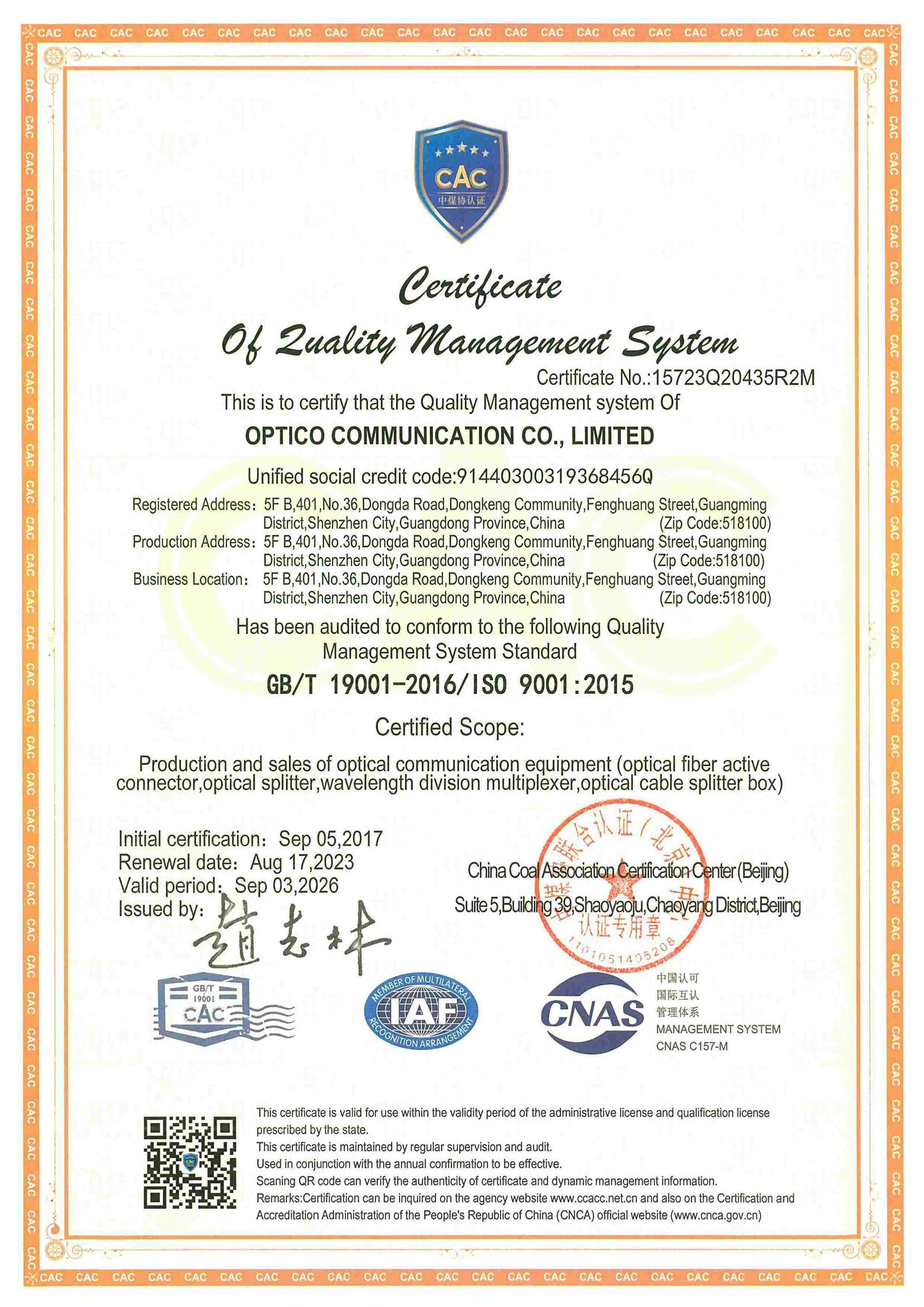


Shenzhen OPTICO Communication Co., Ltd was established in April, 2008. Over the next 13 years, OPTICO expanded and increased its production because of the contracts with many EU Telecom Companies. OPTICO's main products fields including Indoor/Outdoor Fiber Cable, Data Center Fiber Patch cord, PLC Splitter, CWDM/DWDM/AWG/FWDM, SFP transceiver, and Media converter. All of products have passed CE, FCC, ROHS, ISO, ROHS certifications.
Ultimate FAQ Guide to Fiber Cable
We're professional fiber cable manufacturers and suppliers in China, specialized in providing high quality customized service. We warmly welcome you to buy high-grade fiber cable in stock here from our factory. Contact us for more details.
