

Can an 8CH CWDM Module be used in a satellite communication network?
Yo, what's up everyone! I'm a supplier of 8CH CWDM modules, and today I wanna chat about whether an 8CH CWDM module can be used in a satellite communication network.
First off, let's get a bit of background on what an 8CH CWDM module is. CWDM stands for Coarse Wavelength Division Multiplexing. It's a technology that allows multiple optical signals of different wavelengths to travel over a single fiber optic cable. An 8CH CWDM module, as the name suggests, can handle 8 different wavelengths. This is super useful as it increases the capacity of the fiber, letting you send more data at once. You can check out our 8CH CWDM Module for more details.
Now, let's talk about satellite communication networks. These networks are pretty complex. They involve sending and receiving signals between satellites in space and ground stations on Earth. The main goals are to provide wide - area coverage, high - speed data transfer, and reliable communication, especially in areas where traditional terrestrial networks are hard to set up.
One of the key factors in satellite communication is the need for high - capacity data transmission. With the growth of things like satellite TV, broadband internet from space, and remote sensing data collection, there's a huge demand for sending more data through the limited satellite links. This is where the 8CH CWDM module comes in.
The advantage of using an 8CH CWDM module in a satellite communication network is its ability to multiplex multiple signals. Instead of using multiple single - wavelength links, you can combine 8 different signals onto one fiber. This reduces the number of fibers needed, which is a big deal in satellite systems where space and weight are at a premium. Every extra fiber adds to the weight of the satellite, and that means more fuel is needed to keep it in orbit, which is expensive.
Another benefit is cost - effectiveness. Since you're using fewer fibers and can transmit more data on a single one, the overall cost of the communication system can be reduced. You don't have to invest in as many separate transmission lines and associated hardware.
However, there are also some challenges. One of the biggest issues is the harsh space environment. Satellites are exposed to extreme temperatures, radiation, and micrometeoroids. These conditions can affect the performance of the 8CH CWDM module. For example, radiation can cause damage to the optical components, leading to signal degradation or even complete failure.
The long - distance nature of satellite communication also poses a problem. Signals have to travel thousands of kilometers between the satellite and the ground station. Along the way, there can be signal loss due to factors like atmospheric absorption and scattering. The 8CH CWDM module needs to be designed to handle these long - distance transmissions without significant signal degradation.
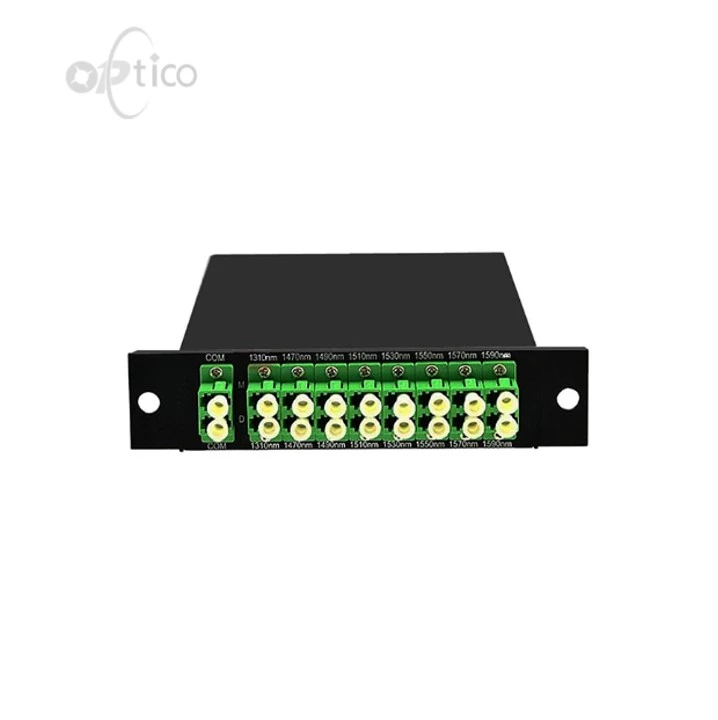

We also need to consider the compatibility with existing satellite communication equipment. Many satellite systems have been around for a while and are based on specific standards and technologies. Integrating an 8CH CWDM module might require some modifications to the existing infrastructure, which can be time - consuming and costly.
When comparing with other CWDM modules, we have the 4CH CWDM Module and the 16CH CWDM Module. The 4CH module has a lower capacity. If you have a high - data - demand satellite communication network, it might not be enough. On the other hand, the 16CH module has a higher capacity, but it might be overkill for some smaller - scale satellite systems. The 8CH CWDM module strikes a good balance between capacity and cost for many satellite applications.
In terms of the future, as satellite technology continues to evolve, the demand for higher - capacity data transmission will only increase. There's a good chance that the use of 8CH CWDM modules in satellite communication networks will become more widespread. New materials and designs are being developed to make these modules more resistant to the space environment. For example, researchers are looking at radiation - hardened optical components that can better withstand the harsh conditions in space.
To sum it up, an 8CH CWDM module can definitely be used in a satellite communication network, but there are some challenges that need to be addressed. If you're in the satellite communication business and are looking for a cost - effective way to increase your data transmission capacity, our 8CH CWDM module could be a great option.
If you're interested in learning more about how our 8CH CWDM module can fit into your satellite communication network, or if you want to discuss a potential purchase, feel free to reach out. We're here to help you find the best solution for your needs.
References:
- "Satellite Communication Systems: Design Principles" by Timothy Pratt and Charles Bostian
- "Optical Fiber Communication Technology" by Gerd Keiser