

What are the future development directions of DWDM Mux Demux technology?
In the ever - evolving landscape of optical communication, Dense Wavelength Division Multiplexing (DWDM) Mux Demux technology stands at the forefront of innovation. As a leading DWDM Mux Demux supplier, I am constantly immersed in the technological advancements and market trends, which enables me to provide valuable insights into the future development directions of this technology.
Higher Capacity and Bandwidth Expansion
One of the most prominent future directions for DWDM Mux Demux technology is the continuous pursuit of higher capacity and bandwidth. With the exponential growth of data traffic, driven by applications such as 5G, cloud computing, and big data analytics, there is an insatiable demand for greater transmission capacity.
DWDM technology allows multiple optical signals of different wavelengths to be combined (multiplexed) and transmitted over a single fiber, effectively increasing the data - carrying capacity of the fiber. In the future, we can expect to see DWDM Mux Demux systems that support even more channels and higher data rates per channel. For example, current systems may support 40 or 80 channels, but in the future, we could see systems with 160 or more channels.
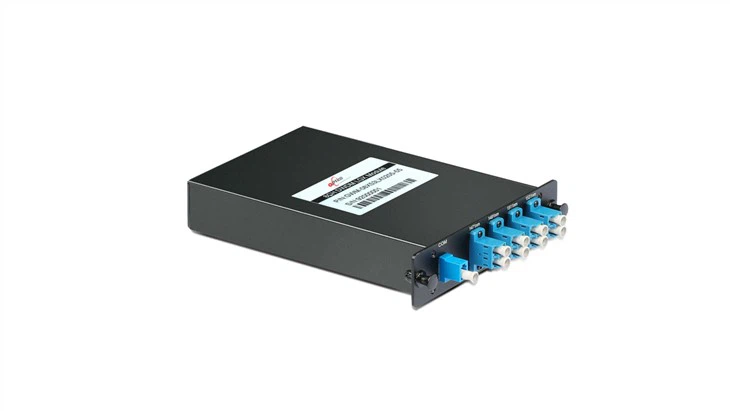
Our company offers products like the 8CH DWDM Module, which is a stepping - stone towards higher - capacity solutions. This module provides a reliable and cost - effective way to increase the capacity of existing fiber optic networks. As the demand for capacity grows, we are also developing advanced modules such as the 200G 20CH DWDM, which can handle much larger amounts of data traffic, making it suitable for high - performance data centers and backbone networks.
Integration with Emerging Technologies
DWDM Mux Demux technology is likely to be increasingly integrated with other emerging technologies to meet the complex requirements of modern communication networks.
5G and Edge Computing
The roll - out of 5G networks has brought new challenges and opportunities for DWDM technology. 5G requires high - speed, low - latency communication, and DWDM can play a crucial role in providing the necessary bandwidth for backhaul and fronthaul connections. Edge computing, which brings data processing closer to the end - users, also relies on high - capacity optical networks. DWDM Mux Demux systems can be integrated into 5G and edge computing infrastructures to enable seamless data transmission between base stations, edge data centers, and core networks.
Artificial Intelligence and Machine Learning
Artificial intelligence (AI) and machine learning (ML) can be used to optimize the performance of DWDM Mux Demux systems. For example, AI algorithms can be employed to monitor and manage the optical signals in real - time, predicting and preventing potential failures. ML can also be used for resource allocation, ensuring that the available bandwidth is used efficiently. By integrating AI and ML, DWDM systems can become more intelligent and self - optimizing, improving the overall reliability and performance of the network.
Miniaturization and Energy Efficiency
As the demand for DWDM Mux Demux technology grows, there is also a need for more compact and energy - efficient solutions.
Miniaturization
Miniaturization of DWDM Mux Demux components is an important trend. Smaller components not only save space but also reduce the cost of installation and maintenance. In data centers, where space is often at a premium, compact DWDM modules can be easily integrated into existing racks and cabinets. Our 100G 20CH AAWG Gaussian module is designed with a focus on miniaturization, offering high - performance in a small form factor.
Energy Efficiency
Energy consumption is a significant concern in large - scale optical networks. DWDM Mux Demux systems consume a considerable amount of power, especially in high - capacity applications. Future developments will focus on reducing the energy consumption of these systems. This can be achieved through the use of more efficient optical components, such as low - loss filters and lasers, and the implementation of intelligent power management strategies.
Enhanced Coherent Detection and Signal Processing
Coherent detection has been a game - changer in optical communication, and its role in DWDM Mux Demux technology is likely to expand in the future.
Improved Sensitivity and Reach
Coherent detection allows for the detection of both the amplitude and phase of the optical signal, providing higher sensitivity and longer transmission reach. In DWDM systems, coherent detection can be used to improve the performance of long - haul and ultra - long - haul transmission. By enhancing the coherent detection capabilities of DWDM Mux Demux systems, we can achieve higher data rates over longer distances without the need for frequent signal regeneration.
Advanced Signal Processing
Advanced signal processing techniques, such as digital signal processing (DSP), are closely related to coherent detection. DSP can be used to compensate for various impairments in the optical signal, such as chromatic dispersion, polarization - mode dispersion, and nonlinear effects. In the future, we can expect to see more sophisticated DSP algorithms integrated into DWDM Mux Demux systems, further improving the signal quality and system performance.
Standardization and Interoperability
Standardization is crucial for the widespread adoption of DWDM Mux Demux technology. As the market for DWDM products grows, there is a need for common standards to ensure interoperability between different vendors' products.
Industry Standards
Industry organizations are working on developing and refining standards for DWDM technology. These standards cover aspects such as channel spacing, wavelength grid, and performance parameters. By adhering to these standards, our company can ensure that our DWDM Mux Demux products are compatible with other components in the network, providing customers with a more seamless and integrated solution.
Interoperability
Interoperability between different DWDM systems is essential for network operators. It allows them to mix and match products from different vendors, providing more flexibility and cost - effectiveness. In the future, we can expect to see greater emphasis on interoperability, with vendors collaborating to ensure that their products can work together smoothly.

Conclusion
The future of DWDM Mux Demux technology is bright, with numerous exciting development directions. Higher capacity, integration with emerging technologies, miniaturization, energy efficiency, enhanced coherent detection, and standardization are all key trends that will shape the future of this technology.
As a DWDM Mux Demux supplier, we are committed to staying at the forefront of these developments. We are continuously investing in research and development to bring innovative products to the market that meet the evolving needs of our customers.
If you are interested in learning more about our DWDM Mux Demux products or discussing potential procurement opportunities, please feel free to contact us. We look forward to working with you to build the next - generation optical communication networks.
References
- Agrawal, G. P. (2010). Fiber - Optic Communication Systems. Wiley.
- Green, R. G. (2012). Optical Networks: A Practical Perspective. Morgan Kaufmann.
- Ramaswami, R., Sivarajan, K. N., & Mukherjee, B. (2018). Optical Networks: A Practical Perspective. Morgan Kaufmann.